




Winds, waves and rain off the western European coasts seen by Swot and nadir altimeters
see also a snapshot with several current data overlaid on Aviso Calval platform: https://seashot.odl.bzh/s/z0E0otqQqzA
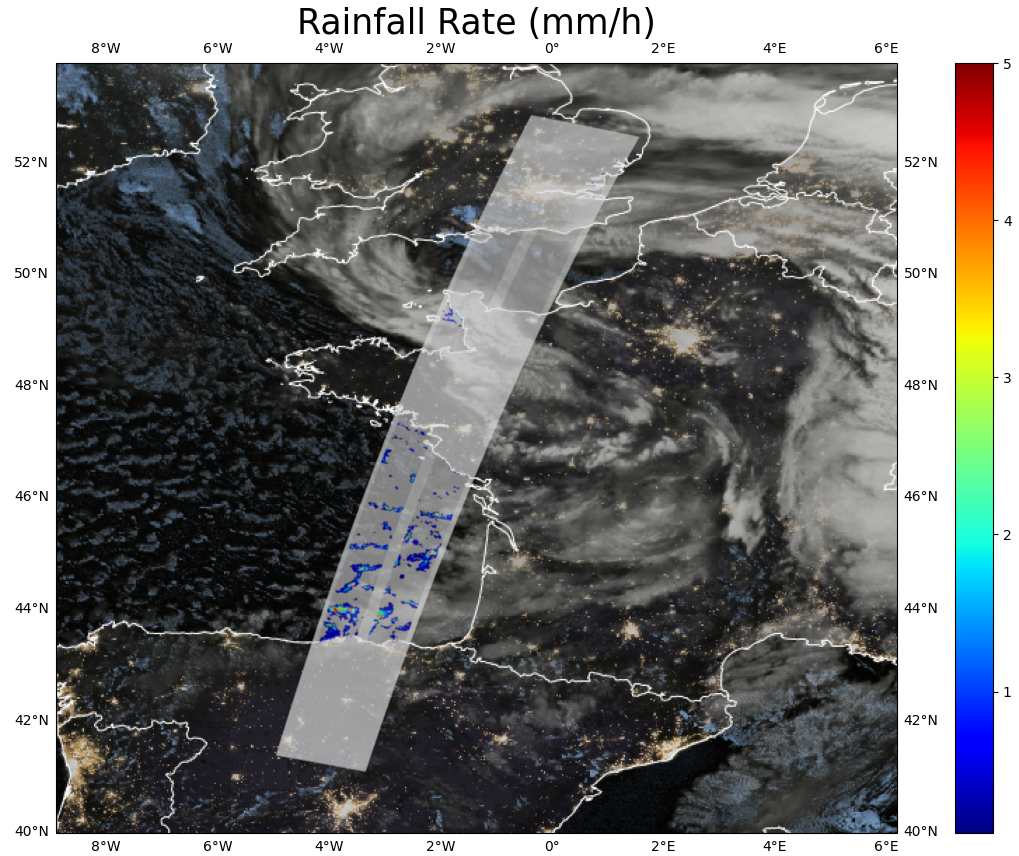
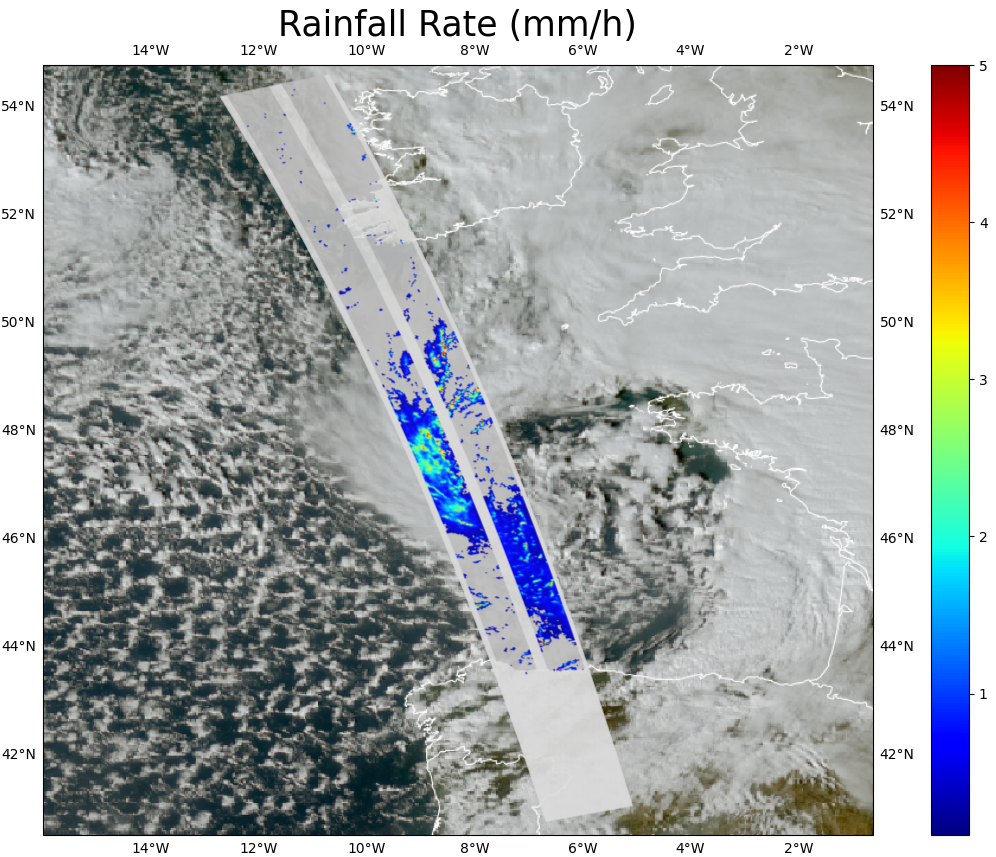
Mid-February two storms, Nils and Pedro, crossed South-west of France, coming from the Atlantic Ocean. As most such winter storms, they lead to high waves and high winds, but they also were heavy with rain – they literally soaked South-west of France, with a number of areas flooded.
Swot, as well as the nadir altimeters measured the Significant Wave Heights under their swath/track, with about 7 to 9.7 m maximum significant wave heights over the period Feb. 9 to Feb 20, 2026. One of the specificities of those storms is that they crossed the continent and continued in the Mediterranean (not unseen, but not their usual path), there also leading to high waves, especially around Corsica.
Concerning KaRIN on Swot (as well as AltiKa on Saral) the wavelength it uses, Ka (i.e. 35 GHz) is more sensitive to water or water vapor in the troposphere than the more often used Ku. It was in fact feared before Saral launch that AltiKa measurements would be degraded under rain. Experience proved that it was not that often the case, and it opened the way to the use of the same bandwidth on Swot. It is, however, sensitive to water in the atmosphere, and rain or water in the troposphere can degrade data, e.g. under storms and cyclones. Moreover, for Swot Significant wave height measurements, heavy rain will decrease the signal-to-noise ratio, thus rendering the Signal-to-Noise decorrelation impossible to exploit for SWH retrieval (the rain flag in the L2 data is giving this kind of information on attenuation). SWH is retrieved using the fact that ocean wave slopes are not smooth, but facetted: the higher the wave, the more small “facets” it has, and those tend to decorrelate the signals interfered. Decorrelation can be measured, and once the other sources of decorrelation have been removed, SWH can be retrieved).
Rain over ocean is intricated within the data and thus can also be retrieved within KaRIn data. A new L3 product will soon be released providing with precipitation rates over the ocean from Swot.
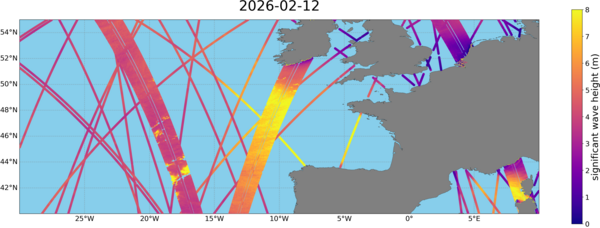
see the animation over the period 09-21 Feb. 2026 on https://youtu.be/zt-COx0_jaY
Reference
Picard, B., A. Colin, R Husson, G. Dibarboure, 2025: The effects of rain on a Ka-band swath altimeter: lessons learned from the SWOT mission. https://doi.org/10.31223/X5WF0Z
Applications
 Ocean .
- Coastal ocean applications .
- Ice and Cryosphere .
- Climate .
- Atmosphere, wind and waves .
- Wind and waves .
- Winds, waves and rain off the western European coasts seen by Swot and nadir altimeters.
- Ex-Hurricane Erin swell on the French coasts.
- Seasonal variations.
- Atlantic storm.
- Southern Swell in the Indian Ocean.
- Rogue waves.
- Sail races .
- Hurricanes .
- Rain.
- Geodesy and geophysics .
- Biology .
- Navigation by area .