





News
Swot, already 3 years old!
Swot was launched three years ago, on December 16, 2022, as part of a collaboration between Nasa/JPL and Cnes, including contributions from UKSA and CSA.
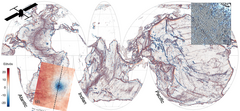
Emerging research confirms Swot's unprecedented observational capabilities. A landmark study in Nature demonstrated Swot's ability to detect submesoscale eddies, which are vortices measuring a few tens of kilometers in size. These eddies were previously difficult to detect using conventional altimetry. A publication in Science highlighted Swot's impact on bathymetric mapping. The study revealed that one year of Swot-derived gravitational anomalies surpasses the resolution achieved by three decades of nadir altimetry. This enables the identification of complex, fine-scale seafloor structures. Swot's high-resolution altimetry has also been instrumental in researching wave dynamics, providing kilometer-scale estimations of significant wave height (SWH), a critical metric for characterizing sea state, improving maritime safety, and refining air-sea interaction models. These advancements collectively position Swot as a paradigm-shifting instrument in satellite oceanography, geodesy, and, of course, hydrology, offering unprecedented monitoring of lake and river water surface level variability.
Cited articles
- Ardhuin, F., T. Postec, M. Accensi, J. Piolle, G. Dodet, M. Passaro, M. De Carlo, R. Husson, G. Guitton, & F. Collard, Sizing the largest ocean waves using the SWOT mission, Proc. Natl. Acad. Sci. U.S.A. 122 (38) e2513381122, https://doi.org/10.1073/pnas.2513381122 (2025).
- Archer, M., J. Wang, P. Klein, et al. Wide-swath satellite altimetry unveils global submesoscale ocean dynamics. Nature 640, 691–696 (2025). https://doi.org/10.1038/s41586-025-08722-8
Yu, Y. , D. T. Sandwell, G. Dibarboure, 2024: Abyssal marine tectonics from the SWOT mission. Science386,1251-1256(2024). DOI:10.1126/science.ads4472
& See much more studies and results on the Swot ST 2025 meeting program
 Archives