





Microplastics distribution in the ocean influenced by eddies
Image of the Month - March 2026
(credit University of Las Palmas de Gran Canaria)
Nowadays plastic pollution is a major concern everywhere in the ocean. The image of a "7th continent", often used, is however misleading, since most of it is microplastic (not macro pieces of plastics) and not floating at the surface. But microplastic pollution vertical distribution in the water column, and its retention within mesoscale structures such as eddies remains unknown.
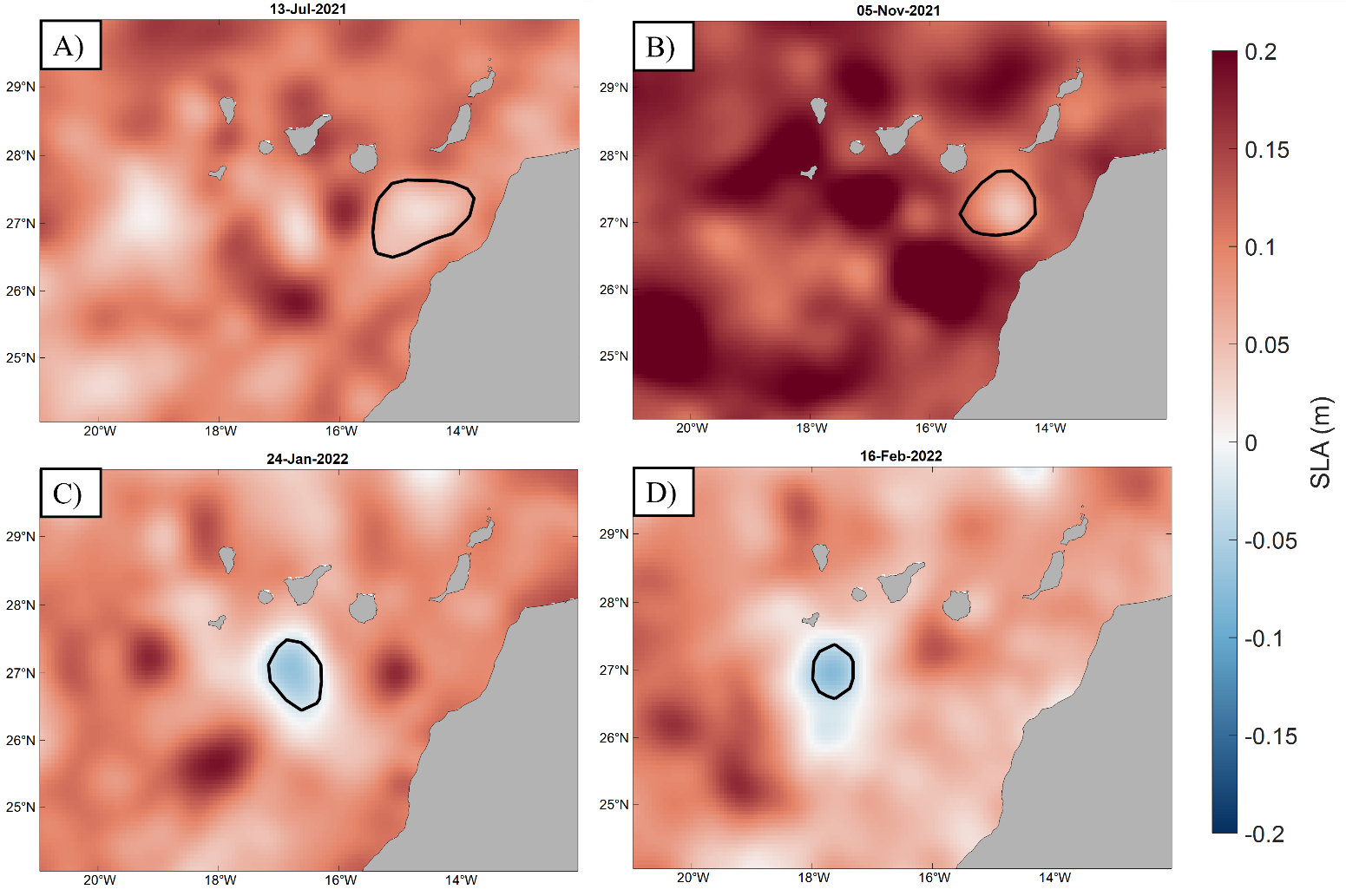
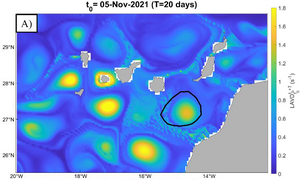
A study from the University of Las Palmas de Gran Canaria examined two mesoscale eddies, one cyclonic, one intrathermocline, south of the Canary Islands in April 2021 and February 2022. These eddies were located, tracked and characterized using the atlas of mesoscale eddies computed from altimetry, to determine their formation, evolution and key characteristics. Moreover, altimetry was used via Lagrangian Coherent Structures to evaluate their coherence. The eddies were also sampled during oceanographic cruises for temperature, conductivity, pressure, dissolved oxygen, pH, turbidity and fluorescence, and seawater was also collected.
The sampling analysis vs the eddies showed that microplastic concentrations were higher in the upper 200 m compared to regional background levels. Small fragments dominated microplastic abundances in both eddies, with fibers significantly more abundant in the cyclonic eddy, while large fragments prevailed in the intrathermocline eddy. The history of a given eddy, its formation but also past merging with another structure has also an impact.
Mesoscale eddies thus seem to act as dynamic reservoirs and transporters of microplastics, with particle-specific retention influenced by eddy type and background ocean dynamics. Tracking them using altimetry can thus help in better understanding of microplatic distribution in the three dimensions of the oceans.
See also:
- Data: Global mesoscale eddy trajectory atlas
- Applications: Mesoscale circulation
News
 Archives .
- Aviso Newsletter .
- Search.
- Front-page news.
- Image of the month .
- 2026 .
- Apr. 2026: Sediment moves in the Ganges-Brahmaputra delta, measured by Swot.
- Mar. 2026: Microplastics distribution in the ocean influenced by eddies.
- Feb. 2026: Swot helps in assessing the tides in estuaries and rivers.
- Jan. 2026: La Niña comes and goes.
- 2025 .
- 2024 .
- 2023 .
- 2022 .
- 2021 .
- 2020 .
- 2019 .
- 2018 .
- 2017 .
- 2016 .
- 2015 .
- 2014 .
- 2013 .
- 2012 .
- 2011 .
- 2010 .
- 2009 .
- 2008 .
- 2007 .
- 2006 .
- 2005 .
- 2004 .
- 2003 .
- 2002 .
- 2001 .
- 2000 .
- 1999 .
- 1998 .
- Operational news and status .