





SWOT- guided sampling reveals distinct phytoplankton communities within a fine-scale front
An adaptive, multidisciplinary sampling strategy guided by SWOT images across a fine-scale front in the North Balearic Sea revealed distinct phytoplankton communities within the front. Unlike highly productive, dynamic regions of the global ocean where opportunistic groups dominate at fronts, a study published on Communication Earth and Environment found that non-dominant groups increased their relative contribution within the front compared to adjacent waters. These results underscore the role of fine-scale variability in maintaining community heterogeneity, suggesting that fronts may act as refuges for non-dominant phytoplankton groups in moderately energetic, oligotrophic conditions.
"In one day we passed through two spaces of water thus stained one of which alone must have extended over several square miles [...] . The line where the red and blue water joined was distinctly defined [...]. The weather for some days had been calm, and the ocean abounded, to an unusual degree, with living creatures [...]. How do the various bodies which form the bands with defined edges keep together ? [...]. what causes the length and narrowness of the bands ? [...] we must believe that the various organized bodies are produced in certain favourable places, and are thence removed by the set of either wind or water"
Darwin, C. (1889). Journal of Researches Into the Natural History and Geology of the Countries Visited During the Voyage of HMS" Beagle" Round the World : Under the Command of Capt. Fitz Roy, RN (T. 1). Ward, Lock ; Company. (Cf. p. 17).
Published in Communications Earth & Environment, the paper 'Fine-scale observations reveal distinct frontal phytoplankton communities' demonstrates that in moderately energetic, oligotrophic conditions, fronts do not necessarily increase total phytoplankton biomass. Instead, they restructure community composition by enhancing the relative contribution of less abundant groups, potentially acting as refuge for non-dominant species. These insights were enabled by an adaptive, multidisciplinary sampling strategy during the BioSWOT-Med cruise in the North Balearic Sea, which utilized SWOT satellite imagery to pinpoint a fine-scale front.
Interview by Tosca Ballerini, SWOT AdaC Communication Officer.
Biophysical sampling across a fine-scale front
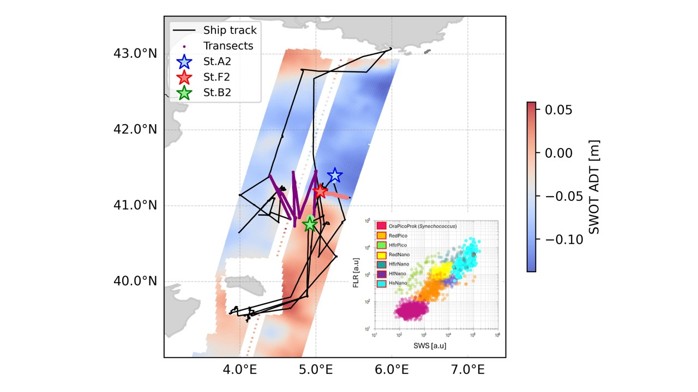
Conducted in spring 2023, the BioSWOT-Med cruise used the first images from the SWOT fast-sampling phase to identify co-occurring fine-scale physical features and biological dynamics in the North Balearic Sea, approximately 100 km northeast of Mallorca. While traditional altimetry depicted the region as relatively flat, SWOT images revealed cyclones and anticyclones of a few tens of kilometers large. Ocean color data qualitatively confirmed these findings, aligning SWOT-derived current features with chlorophyll concentration gradients. In addition, in situ sea surface salinity measurements collected during the cruise confirmed the presence of a fine-scale frontal zone, consistent with both SWOT altimetry and ocean color observations.
To address the question of whether the phytoplankton community within the front is significantly different from those in surrounding waters, an adaptive, multidisciplinary sampling strategy was applied. This approach involved repeated transects across the fine-scale, followed by 24-hour drifting stations positioned within the front and in the two adjacent water masses. Throughout both phases, high-resolution underway data on phytoplankton biomass and community composition were collected via flow cytometry, while simultaneous hydrological properties (temperature and salinity) were recorded using a thermosalinograph (TSG).
An unprecedented dataset with exceptional spatiotemporal resolution
"Plankton are non-swimming organisms, whose displacements are mainly due to passive transport by currents. A way to understand them is then to place ourselves in a plankton point of view. The Lagrangian stations we deployed during BioSWOT-Med aimed to passively follow fine-scale currents. The positions of these Lagrangian stations were carefully chosen using a range of different methods and instruments, involving daily SWOT images, in-situ and real-time TSG data, and Lagrangian instruments (buoys). These different methods and instruments provided us accurate spatio-temporal information on fine-scale dynamics, making it possible to target a fine-scale front and stay within it during 24 hours. Phytoplankton cells were sampled along fine-scale features, ie. along their own drifting in trajectories in the currents, thank to an automated flow cytometer. This approach permitted us to collect a uniquely high-frequency biological dataset, (only 15’, corresponding for a ship speed of 6 knots of roughly 460 meters !)" says Laurina Oms, first-author of the study.
Overall, the BioSWOT-Med cruise implemented a sampling strategy specifically adapted for fine-scale plankton research through its Lagrangian framework. A distinguishing feature of the expedition was its commitment to environmental stewardship, maintaining a maximum vessel speed of 6 knots throughout the entire cruise to minimize disturbance.
Increase of non-dominant phytoplankton groups within the front
Statistical analysis of the biological dataset revealed that the phytoplankton community composition within the fine-scale front in the North Balearic Sea differed significantly from that of surrounding waters. Specifically, while total phytoplankton biomass remained unchanged, the relative abundance of non-dominant groups increased within the frontal zone compared to adjacent water masses.
These findings suggest that in moderately energetic, oligotrophic conditions like those of the Mediterranean Sea, fronts do not drive surface biomass accumulation but instead restructure community composition by favoring less abundant groups. This contrasts with observations in more energetic regions of the global ocean, where fronts typically enhance total biomass.
"In dynamical and productive regions, such as the California Current Ecosystem, it is observed that fronts enhance phytoplankton biomass, in particular the biomass of fast-growing groups such as diatoms. The distinct phytoplankton communities thus observed at fronts are mostly attributed to a significant nutrient supply upwelled in surface layers by positive vertical velocities created by the frontogenesis , which could hide other frontal effects on phytoplankton communities, such as vertical stratification, shearing, and stretching, or more generally the ephemeral and dynamic nature of fronts that could be hostile to sustaining life. In the oligotrophic conditions we encountered during BioSWOT-Med, we discovered that even a front with weaker dynamics (and no high nutrient supply) could host a distinct phytoplankton community, characterized by a distinct relative composition, without an overall increase in total phytoplankton biomass. This was also observed in the oligotrophic region of the canary Islands" says Oms.
Fine-scale fronts may act as refuge for non-dominant phytoplankton species
Based on these results, researchers have hypothesized that fine-scale fronts might act as a refuge for non-dominant phytoplankton groups in oligotrophic, low-energy environments.
"We have several hypotheses to explain the increase in the relative abundance of non-dominant phytoplankton groups, which deserve to be tested by reconstructing the full story of the cruise, i.e., putting together results from the different instruments (including genomics, nutrients, vertical velocity, zooplankton, etc.). However, one hypothesis could lie in the different ecological strategies that distinct phytoplankton species employ to maintain themselves. Frontal environments may favor organisms with broad ecological niches and high physiological flexibility. Such generalist species can tolerate rapid environmental variability and maintain growth under unstable conditions. In contrast, specialist species, well-adapted to the more stable background environment, may be disadvantaged within fronts. Consequently, frontal systems may promote non-dominant but flexible, broadly-tolerant taxa rather than dominant, specialized ones. In oligotrophic environments, where trophic chains are longer and relatively stable, frontogenesis may catalyze shifts in community structure. By disturbing established trophic interactions and physical forcings, fronts could disadvantage specialist species and create transient opportunities for non-dominant groups," says Oms.
Relevance to society
A deeper understanding of the processes that modify phytoplankton community composition, including in oligotrophic and moderately energetic regions, is crucial for predicting plankton dynamics and their responses to global change.
“I think that for the society there is always a need to know more about life, to deeply understand how complex and precious it is, and especially to highlight the close links existing between all living organisms, including humans. The findings of our work are one piece of the giant puzzle of marine biology and each piece of the puzzle is linked somehow to the others. Without understanding plankton dynamics we will be not able to explain why sometimes we observe birds far away from the coast, nor to understand the functioning of carbon and nutrient cycles, or why it is "snowing" in the deep ocean ... Climate change affect habitats and plankton populations, and so their dynamics. We know, thanks to the recent literature and now thanks to our study, that fine-scale physical features are important in determining the biogeography, the shape, and the structure of plankton communities. If we add these dynamics into predictive biogeochemical models, will our estimations of changes in the functioning of marine ecosystems and of biogeochemistry for future years be more correct?" asks Oms.
The work was supported by CNES TOSCA and the ANR–FRANCE (French National Research Agency) ANR-23-CE01-0027.
Citation:
Oms, L., Doglioli, A., Messié, M. et al. Fine-scale observations reveal distinct frontal phytoplankton communities. Commun Earth Environ 7, 468 (2026). doi.org/10.1038/s43247-026-03350-0
Missions
- Timeline Altimetry.
 Past missions .
- Current missions .
- Cryosat .
- Saral .
- Jason-3 .
- Sentinel-3A .
- Sentinel-3B.
- CFOSAT .
- HY-2B.
- HY-2C.
- HY-2D.
- Sentinel-6MF .
- Swot .
- SWOT Links and References.
- Objectives & Applications .
- Program.
- SWOT Ocean Data Access.
- Instruments .
- Data products.
- Error budget.
- Orbit .
- Portfolio of Swot first results .
- SWOT- guided sampling reveals distinct phytoplankton communities within a fine-scale front.
- SWOT reveals swells that connect ocean storms and mysterious seismic activity.
- Swot observations of internal tides analyzed.
- A third tsunami observed by Swot, due to Kamchatka earthquake.
- Swot observes interactions between waves, winds, and currents.
- Swot tracks significant inflow of oxygen-rich waters to the Baltic Sea.
- Tsunami waves observed by Swot for the second time.
- Waves trapped along the coasts monitored by altimetry, thanks to Swot (and others).
- Little eddy in a big ocean, seen by Swot.
- Computing vertical mixing from Swot sea surface heights.
- Earthshaking waves from a landslide observed by Swot in a fjord.
- Swot & swell.
- Changing scale in eddy observation.
- Gibraltar's internal wave viewed by Swot.
- Global view of seafloor gravity and bathymetry from one year of Swot.
- Swot close to the coasts.
- Sea ice observed by Swot.
- Swot monitors its first El Niño.
- Currents in 2 dimensions.
- Internal tides by Swot.
- Mega-icebergs seen by Swot.
- Video with First Swot images.
- Rapid-changing ocean circulation seen thanks to the 1-day orbit.
- Swot's detailed view of the ocean.
- Swot scans the Southern Ocean.
- Sea-surface heights in a part of the Gulf Stream off the coasts of America seen by Swot.
- Highly detailed views of surface water in the region around Toulouse.
- Swot first (nadir) ocean altimetry data.
- First waveforms over river from the nadir altimeter on Swot.
- Changing scale in eddy observation.
- Visualisation.
- Utilizing CNES HPC infrastructure for Swot project hosting.
- Mission performances (Nadir).
- Sentinel-6B.
- Future missions .