





Swot reveals swells that connect ocean storms and mysterious seismic activity
A study published in the journal Nature Communications identifies a causal relationship between the occurrence of large storms in the Southern Ocean and, a few days later, bursts of microseisms with periods around 16 and 26 s, radiating from the Gulf of Guinea. The hidden link between these two phenomena are swells radiated from the storms and revealed in sea surface height maps by the SWOT satellite. When the swell wavelength is around 1 km, the swell period is 26 s. Only a few centimeters of swell height is enough to trigger a clear seismic signal. As SWOT only measures every 10 days, the SWOT data was complemented by numerical wave models. SWOT data was critical to validate the ocean wave model that was used to identify the origin of the swells that arrived in the Gulf of Guinea and triggered the seismic activity. This work supports a conceptual model of the interaction between the atmosphere, hydrosphere and solid Earth in which this type of seismic signals, discovered in the 1960s but still unexplained, are associated with fluid reservoirs dynamically triggered by swell activity, in turn influenced by storms. Interview with Fabrice Ardhuin, SWOT project investigator and co-author of the paper, by Tosca Ballerini.
The paper Swell-driven bursts of 26 s and 16 s seismic spectral peaks in the Gulf of Guinea (https://www.nature.com/articles/s41467-026-71541-6) published in Nature Communications identifies the causal relationship between the occurrence of severe Southern Ocean storms and a narrow-band of seismic activity energy in the Gulf of Guinea. These seismic signals were first observed in 1961 by Jack Oliver - the American scientist whose studies on earthquakes provided seismic evidence supporting plate tectonic - and their source was traced to the Gulf of Guinea, but they were still unexplained until today.
What is particular about these seismic signals and why have they puzzled researchers since their discovery?
Microseisms are motions of the Earth's crust that have typical periods from 2 to 20 s that are recorded everywhere on Earth. While Klaus Hasselmann [Nobel Prize in Physics in 2021] explained in 1963 how usual microseisms are caused by ocean waves that have either the same period or half their period, the very particular signal at 26 s and its single origin in the Gulf of Guinea have puzzled seismologists since their discovery. The 26 s signal has a very narrow frequency range, that cannot be explained by standard microseism excitation alone. A recent study (https://www.nature.com/articles/s43247-023-00837-y) by Charlotte Bruland and Celine Hadziioannou pointed out that the 26 s signal is usually accompanied by a "chirp" pattern of decreasing seismic period over a few days. That pattern was also called “gliding tremor” in the context of noise related to volcanic activity and is typical of swells arriving from distant storms. That study did not identify the storms that could make these extremely long swells, and instead concluded “An additional complication is finding an explanation for both the [gliding tremors] and the continuous 26 s signal simultaneously. Regardless, the nature of the Gulf of Guinea tremors forces us to broaden our thinking about the mechanisms and systems causing gliding tremors, and about the mysterious signals the Earth produces”.
How does this work help explain this puzzle?
The present work fills in two important pieces of the puzzle. The first piece is the identification of the storms from which the gliding tremors can be explained using standard microseism theory, which links the seismic wave energy to the action of the swell-induced pressure on a sloping ocean floor. The second puzzle piece, is borrowed from the analysis of similar but shorter period seismic oscillations in different situations (volcanoes, glaciers...): it is a model for the additional amplification mechanism for narrow frequency bands around 16 s and 26 s. This amplification is a bathtub-like resonance, with the bathtub replaced by a large fluid-filled crack in the shallow crust.
The first puzzle piece use ocean-wave models validated with satellite observations, and a new method for the analysis of seismic data that provides high temporal resolution of very weak signals. The ground motion with periods 16 s and 26 s, is observed every hour, and it has amplitudes less than 10 nanometers in West Africa. These events start exactly when swells of period 16 s and 26 s arrive in the Gulf of Guinea, setting in motion the ground and any fluid reservoir within it.
Such 16-s or 26-s swells occur all around the world, so why is that kind of source only found in the gulf of Guinea?
This is where the second puzzle piece is needed: something very special - unique in the world coastal ocean - is amplifying the wave motion. Without any direct observations the most likely explanation is a fluid-filled cavity in the solid Earth. The resonant period and time evolution of the energy give some constraints on the shape of this cavity, 2 to 20 km long, 2 to 20 m wide, but it does not rule out the fluid that may be contained in it which could be water, oil or basaltic magma.
How did you use SWOT observations to validate the swell model?
Numerical wave models have long been developed to reproduce dominant waves generated by the wind that are important for the safety of navigation and operations at sea. These dominant waves have never been measured with periods above 20 s. The longer waves, which were called “forerunners” by Walter Munk, are not created by the wind but instead take their energy from the dominant waves through a process called the “inverse cascade”, in which different wave components exchange energy. This inverse cascade is very important for the amplification of the dominant waves and adds-up to the direct wind effect. Numerical models used for weather forecasting have a rather crude representation of that inverse cascade. The forerunners that arrive in the Gulf of Guinea and generate the seismic signals have wave heights under 10 cm and wavelengths up to 1 km: these are impossible to see with the naked eye and impossible to measure with open ocean wave buoys. Before SWOT, there was no validation for these waves in that region, and trusting numerical models was an act of faith. SWOT provides unique measurements of swell height, period and direction obtained from maps of surface elevation.
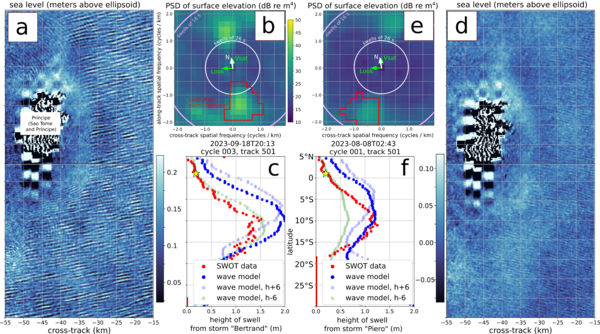
Having SWOT measurements confirmed the presence of the long swells and gave precise measurements of their height, which is the most difficult to get with a wave model. Figure S3 shows the original SWOT map for two swell events, and its transformation into a swell “spectrum” that decomposes the swell energy as a function of wavelength and direction. These spectra can be summarized in more usual parameters: swell height, period and direction. Whereas the model period and direction is generally accurate, the heights of the long swells is generally too large, and the maximum swell height occurs about 6 hours too early.
An experimental SWOT-derived WIND-WAVE Level 3 product (https://doi.org/10.24400/527896/a01-2024.016) is now being extended to cover the full SWOT archive, and provide new reference measurements for the long swells (period longer than 18 s).
Your results show that there is an ocean triggering of seismic activity. What are the most important factors of this triggering?
The statistical analysis of oceanic and seismological data show that the height and the specific period of swell activity play a critical role in triggering the seismic signals. The study demonstrate the link between the occurrence of long swells and the bursts of 26 s and 16s microseismic peaks. The 26 s events arrive first because longer period waves travel faster. The swell period is the most important factor and swell height can be as low as a few centimeters to trigger a significant seismic response allowing to quantify the contribution of ocean activity in modulating the seismic signal.
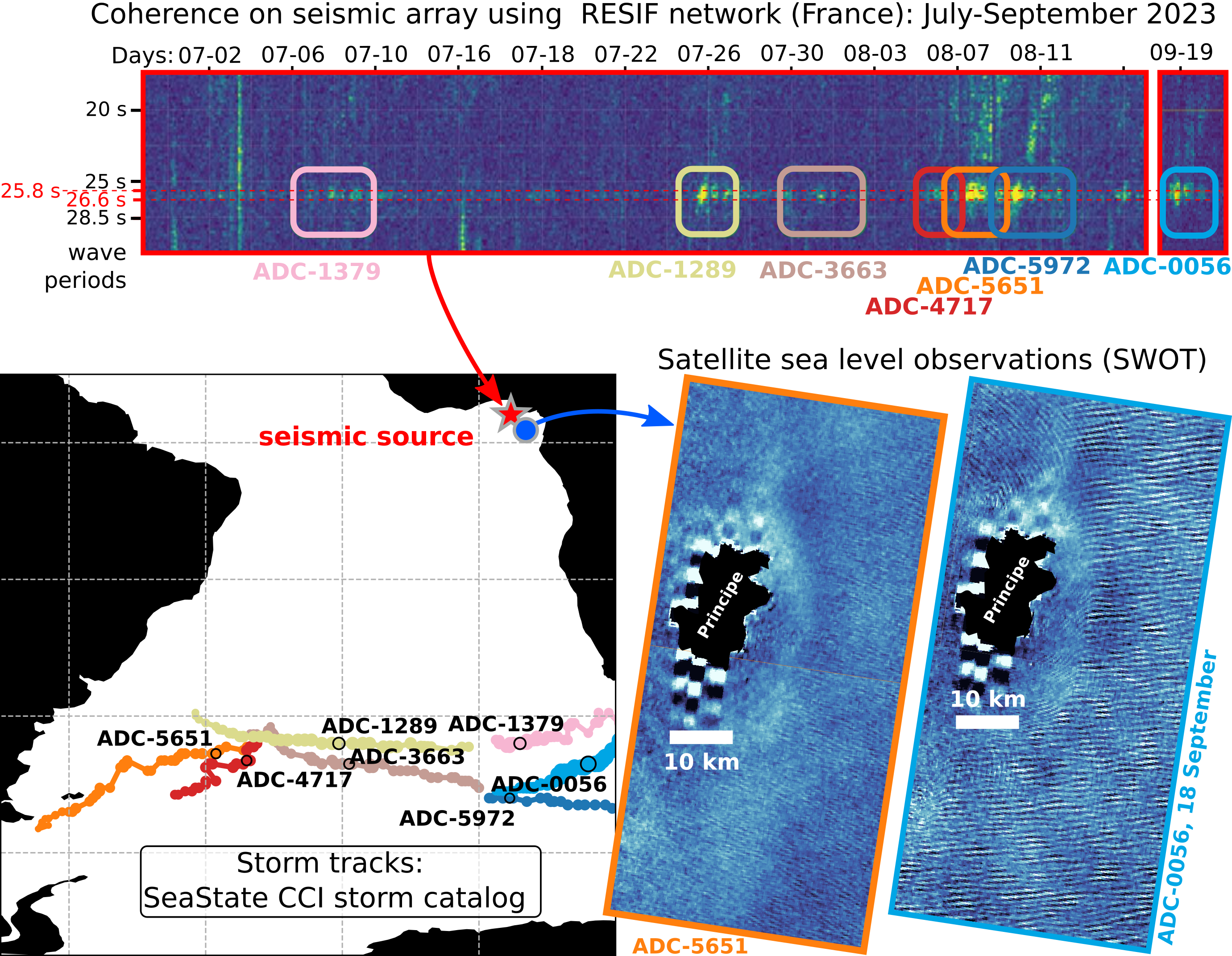
The paper demonstrates the existence of a resonance between swell arriving in the Gulf of Guinea (from Southern Ocean storms) and the seismic source mechanism in the Gulf of Guinea for the 26s and 16s spectral peaks of microseismes. In particular, these spectral peaks are excited only when ocean swells of comparable periods arrive in the Gulf of Guinea. How can these observations be interpreted?
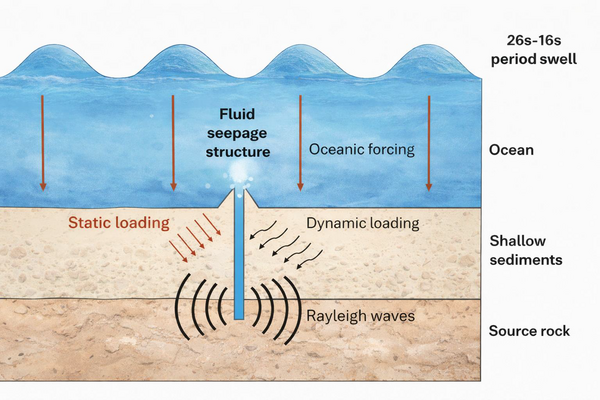
Taken together, these observations and modeling results support the interpretation of dynamically triggered, fluid-filled crack-like structures that resonate independently in response to frequency-dependent swell forcing. Such structures are consistent with the documented abundance of fluid-related features within the sedimentary cover of the Gulf of Guinea. Overall, our results provide a coherent and physically grounded explanation for the long-standing observations of the 16-s and 26-s seismic signals.
What is the relevance to society of this study and how it helps in understanding the interactions between the atmosphere, hydrosphere and solid Earth?
A better understanding of how ocean waves generate microseism can help expand our knowledge of extreme storms from the satellite era to the past century. This study will certainly lead to a revisit of the storm conditions of the original June 1961 discovery of what was a mysterious seismic signal. The analysis of SWOT data in this and a previous study (https://doi.org/10.1073/pnas.2513381122) also point to deficiencies in wave forecasting systems. Work is ongoing to update model parameterizations with a better representation of the energy inverse cascade.
The 26 s seismic signal had been one of the few signals for which we did not yet have a quantitative model to explain the measurements. With this very particular source we should be able to improve on numerical wave models, with calibration using SWOT data if necessary, to further investigate the generation and propagation of the seismic waves. In particular a well known source can produce some interesting constraints on the properties of the solid Earth.
What is the relevance to society of using SWOT to study ocean waves?
As I said above, results from this study will motivate us to further improve numerical wave models that have errors of the order of 50% for the wave heights of fore-runners, with arrival time that can be off by half a day.
The better understanding of ocean waves is not the main science goal of SWOT but as we better understand this signal, it helps in the better definition of "noise" for other applications, in particular the retrieval of ocean currents. Besides, the influence of currents on waves may be another way to constrain ocean currents.
How do insights by using SWOT in validating the ocean model suggest to improve ocean models?
There is clearly a problem with the computation of the inverse cascade in ocean models. We’ve known about it for 40 years, but we did not have such obvious evidence of the problem. Now that we have observed these very long swells with SWOT, it is time to replace the old “Discrete Interaction Approximation” by something more accurate. A big limitation was the computational cost of exact methods. Some neural-network approaches have been proposed and we are working on a hybrid combination of exact method in storms and approximate solution outside of storms to bring down the cost and make it compatible with today’s high spatial resolution models.
Citation:
Poli, P., Ardhuin, F., Takano, T. et al. Swell-driven bursts of 26 s and 16 s seismic spectral peaks in the Gulf of Guinea. Nat Commun (2026). https://doi.org/10.1038/s41467-026-71541-6
Other relevant papers on SWOT and ocean waves:
- Ardhuin,F.,Molero,B.,Bohé,A., Nouguier,F.,Collard,F.,Houghton,I., etal.(2024). Phase‐resolved swells across ocean basins in SWOT altimetry data: Revealing centimeter‐scale wave heights including coastal reflection. Geophysical Research Letters, 51, e2024GL109658. https://doi.org/10.1029/2024GL109658
- Ardhuin, F., Postec, T., Accensi, M., Piolle, J.F., Dodet, G., Passaro, M., De Carlo, M., Husson, R., Guitton, G. and Collard, F., (2025). Sizing the largest ocean waves using the SWOT mission. Proceedings of the National Academy of Sciences, 122(38), p.e2513381122. https://doi.org/10.1073/pnas.2513381122
- Postec, T., Dodet, G., Ardhuin, F. (2026). Wave, Wind and Sea Level Observations Across an Atoll Barrier Reef-Lagoon System from Wide Swath Radar Altimetry. In: Coelho, C., Hallin, C., Sancho, F., Silva, P.A. (eds) Coastal Dynamics 2025. CD 2025. Coastal Research Library, vol 42. Springer, Cham. https://doi.org/10.1007/978-3-032-15477-4_68
Missions
- Timeline Altimetry.
 Past missions .
- Current missions .
- Cryosat .
- Saral .
- Jason-3 .
- Sentinel-3A .
- Sentinel-3B.
- CFOSAT .
- HY-2B.
- HY-2C.
- HY-2D.
- Sentinel-6MF .
- Swot .
- SWOT Links and References.
- Objectives & Applications .
- Program.
- SWOT Ocean Data Access.
- Instruments .
- Data products.
- Error budget.
- Orbit .
- Portfolio of Swot first results .
- SWOT- guided sampling reveals distinct phytoplankton communities within a fine-scale front.
- SWOT reveals swells that connect ocean storms and mysterious seismic activity.
- Swot observations of internal tides analyzed.
- A third tsunami observed by Swot, due to Kamchatka earthquake.
- Swot observes interactions between waves, winds, and currents.
- Swot tracks significant inflow of oxygen-rich waters to the Baltic Sea.
- Tsunami waves observed by Swot for the second time.
- Waves trapped along the coasts monitored by altimetry, thanks to Swot (and others).
- Little eddy in a big ocean, seen by Swot.
- Computing vertical mixing from Swot sea surface heights.
- Earthshaking waves from a landslide observed by Swot in a fjord.
- Swot & swell.
- Changing scale in eddy observation.
- Gibraltar's internal wave viewed by Swot.
- Global view of seafloor gravity and bathymetry from one year of Swot.
- Swot close to the coasts.
- Sea ice observed by Swot.
- Swot monitors its first El Niño.
- Currents in 2 dimensions.
- Internal tides by Swot.
- Mega-icebergs seen by Swot.
- Video with First Swot images.
- Rapid-changing ocean circulation seen thanks to the 1-day orbit.
- Swot's detailed view of the ocean.
- Swot scans the Southern Ocean.
- Sea-surface heights in a part of the Gulf Stream off the coasts of America seen by Swot.
- Highly detailed views of surface water in the region around Toulouse.
- Swot first (nadir) ocean altimetry data.
- First waveforms over river from the nadir altimeter on Swot.
- Changing scale in eddy observation.
- Visualisation.
- Utilizing CNES HPC infrastructure for Swot project hosting.
- Mission performances (Nadir).
- Sentinel-6B.
- Future missions .