




This release of the AVISO GMSL indicators includes several important changes regarding input data and processing software. For a detailed description of these changes and their impact, please refer to the release note, the data processing and geophysical corrections documentation, and in particular the technical note.
Mean Sea Level
As global warming progresses, one direct response of the climate system is rising sea levels. This increase is caused by two main factors: the thermal expansion of seawater due to ocean heat absorption and the addition of meltwater from land-based ice sheets and glaciers. Satellite altimetry provides precise monitoring of sea level rise, helping scientists understand climate change and its socioeconomic impacts. As a result, the Global Mean Sea Level (GMSL) has become a crucial indicator of climate change.
Continuous altimetry observations, spanning from 1993 to the present, have established the GMSL rise as a key climate indicator. On the one hand, the global ocean absorbs over 90% of the excess heat accumulated in the climate system due to rising atmospheric greenhouse gas concentrations. Consequently, ocean temperatures rise, causing seawater to expand. On the other hand, the accumulated heat accelerates the melting of polar ice caps (Greenland and Antartica) and mountain glaciers. The resulting meltwater increases ocean mass, contributing to the observed sea level rise detected by satellites since 1993.
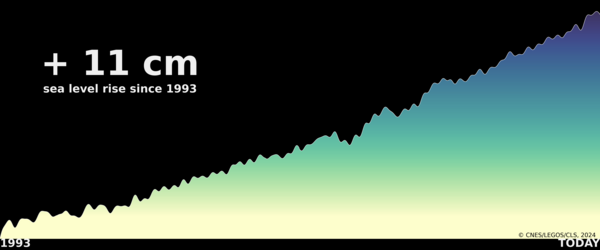
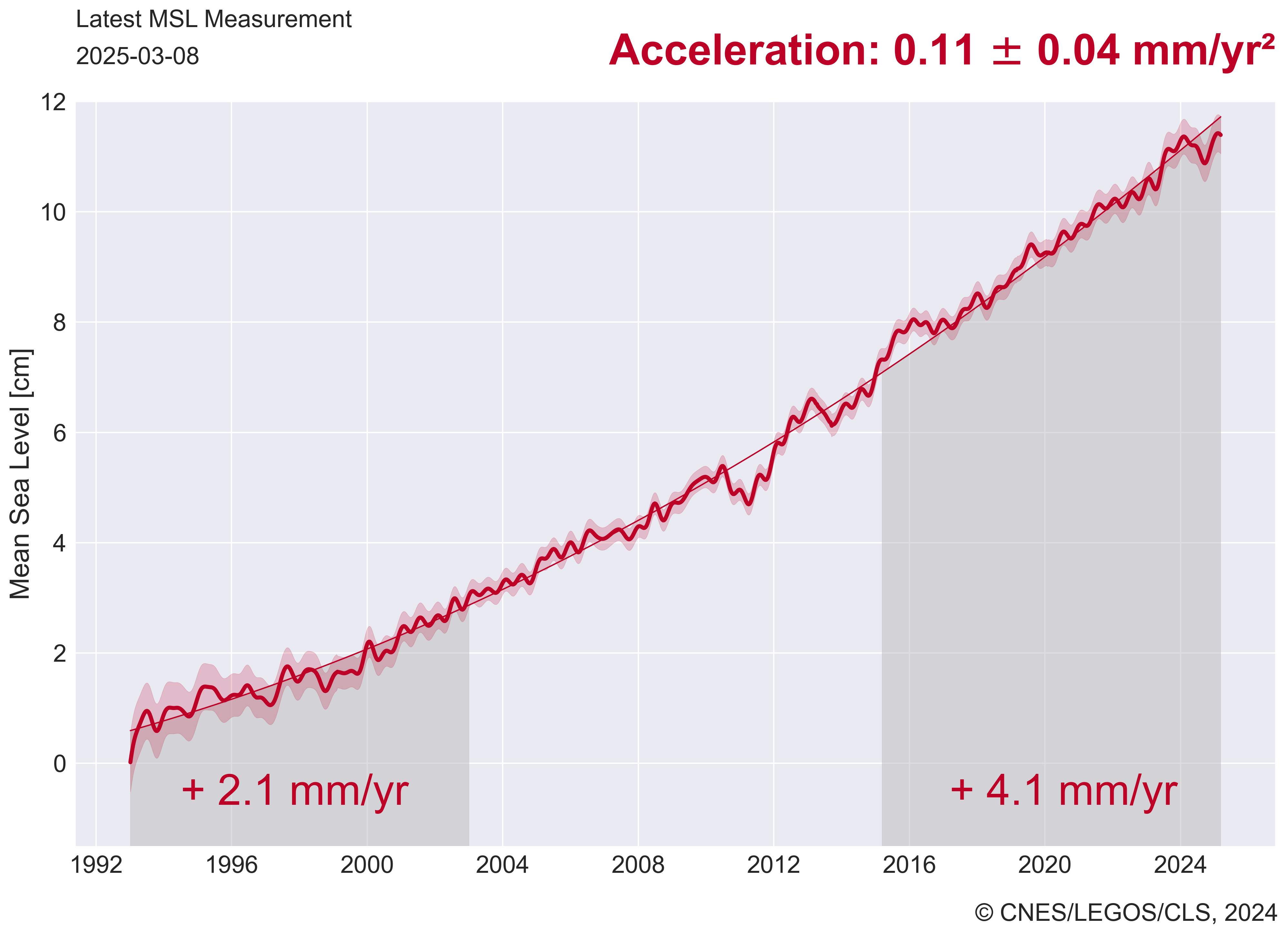
Since February 1993, the GMSL has risen by approximately 11 cm.
Data access and product information
 |  |  | ||||
Data access | Global scale | Regional scale |
AT THE GLOBAL SCALE
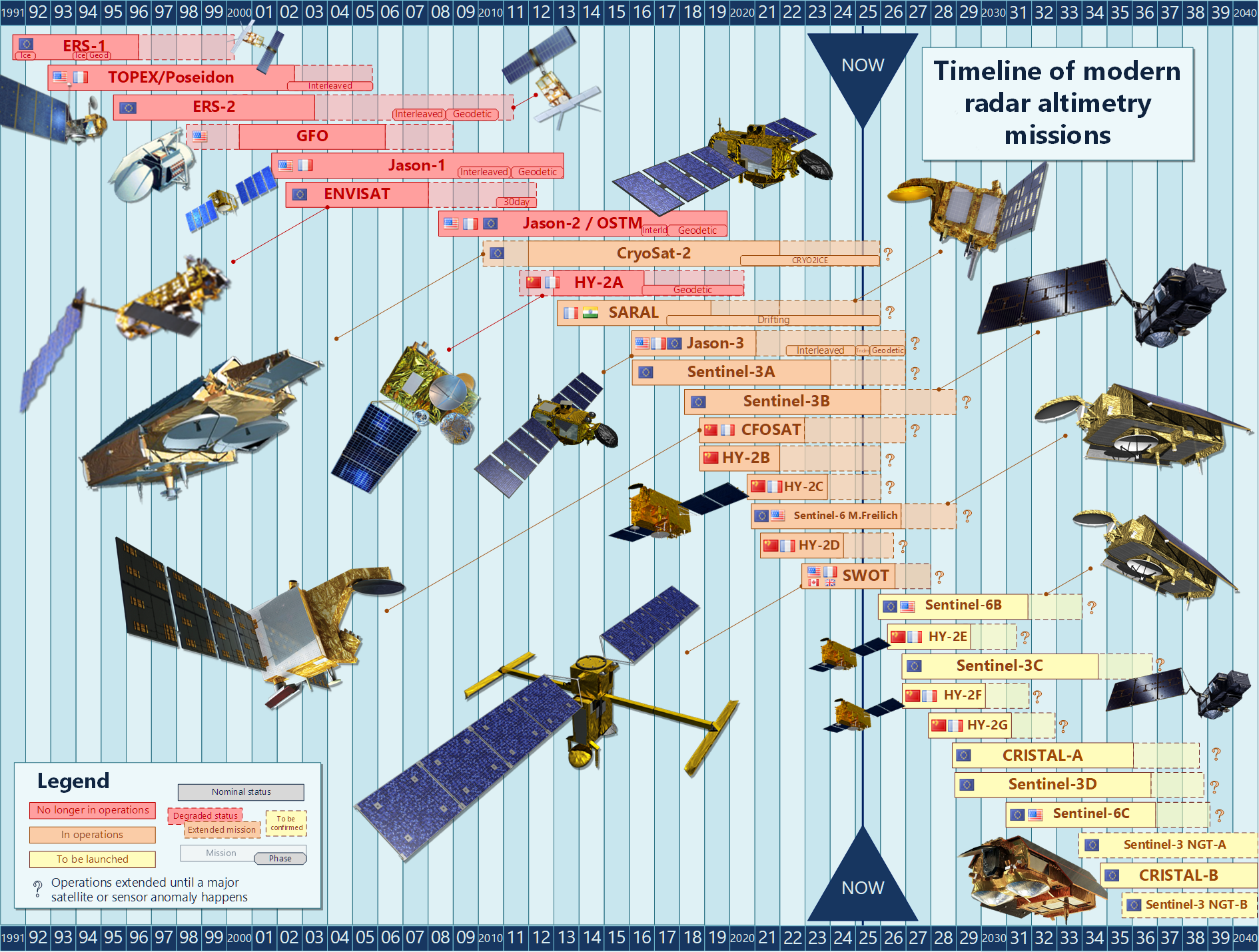
Different satellite altimetry missions have been monitoring the GMSL successively and continuously since 1993: TOPEX/Poseidon, Jason-1, Jason-2, Jason-3 and Sentinel-6 MF. These missions are called "reference missions" as they fly on a well-determined reference orbit that is unchanged since 1993. Dedicated calibration phases between the successive missions, during which the satellites fly a few second apart, help to ensure the long-term stability and precise monitoring of the sea level. In addition, a permanent control of the data quality and instrumental performances, in combination with the homogenization of the data processing and geophysical corrections , are key to produce homogeneous data that well capture the long-term evolution of the sea level.
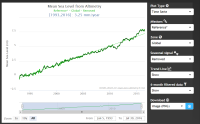
The average sea level rise rate is 3.6 mm per year (+/-0.3 mm/yr, 90%CI) over the globe and from 1999. There is also evidence that sea level rise is accelerating (eg Nerem et al., 2018, Guérou et al.,2023), over the altimeter record, this acceleration is estimated at 0.8 mm per year per deacade (+/- 0.4 mm/yr/decacde, 90%CI). Analyzing the uncertainty of the altimetry observing system yields to construct an uncertainty envelop for the GMSL climate data record (shaded area in the figure below, given at the 1 sigma level).See Guérou et al. (2023) for more details as well as the Validation page for some updates.
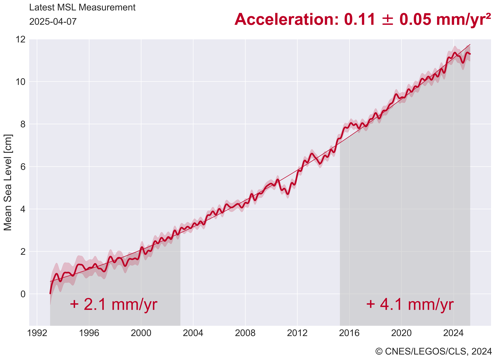 |
The uncertainty envelope associated with the time series shown in this figure is available in delivered products. This envelope is the square root of the diagonal of the covariance matrix obtained from the uncertainty budget detailed in Quet et al. 2025 [in prep.]. This uncertainty budget table used is available from the data processing and geophysical corrections page. In the latest release of the GMSL indicators and the switch to updated along-track data to estimate the GMSL record, the processing of the early part of the record from 1993 to 1999 has changed. A discussion about the reasons for this change is available from the data processing and geophysical corrections page.
AT THE REGIONAL SCALE
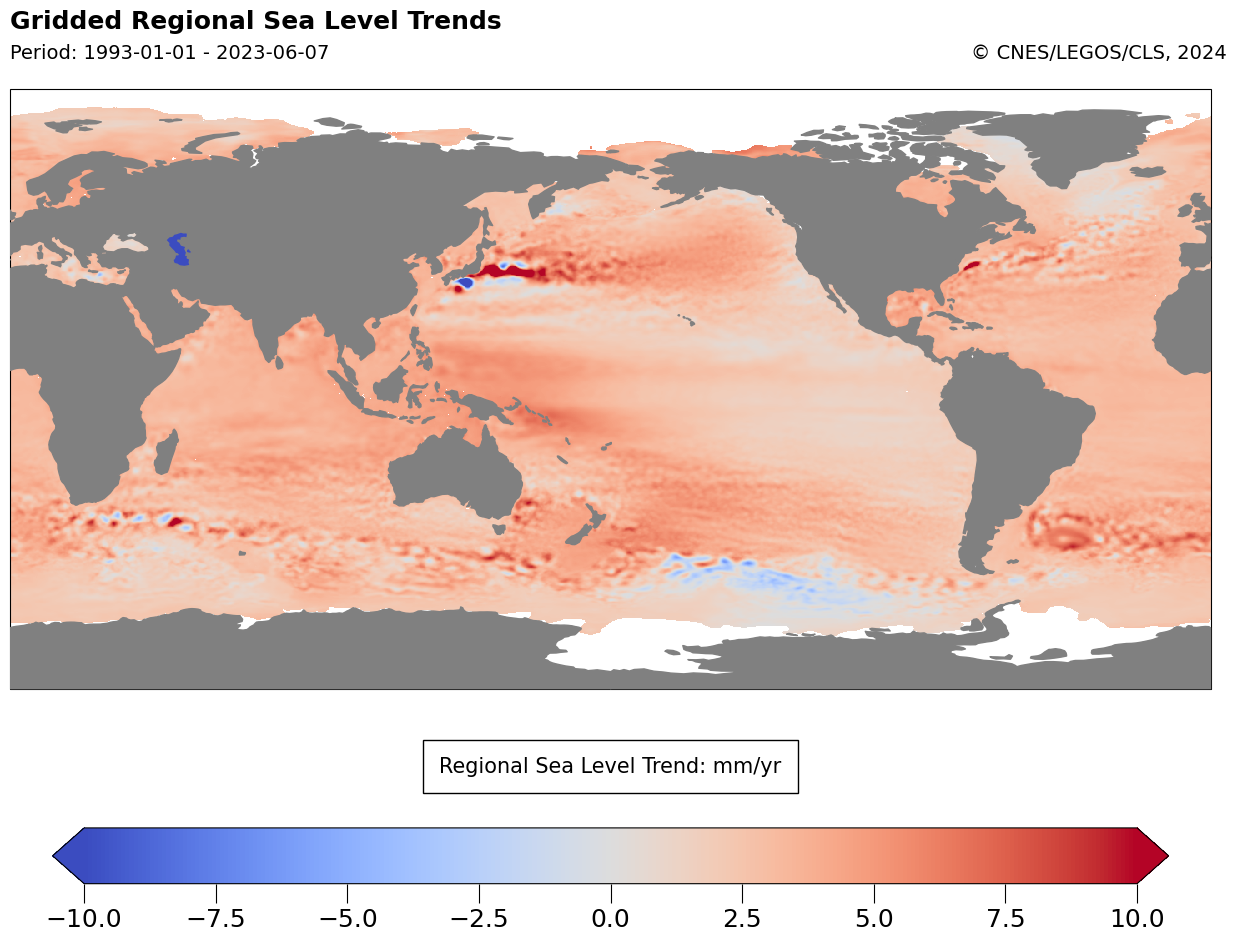
The GMSL curve masks significant regional variability in mean sea level, with some regions rising three times faster than the global average. This spatial variability is mainly due to the redistribution of heat under the influence of major climate oscillations, in particular the Southern Oscillation/El Niño, the Pacific Decadal Oscillation, and the North Atlantic Oscillation. Regional trends in mean sea level also reflect variations at different spatial scales, from large-scale structures in ocean basins to finer mesoscale structures in major currents such as the Gulf Stream, the Kuroshio, and the Southern Circumpolar Current (around Antarctica). Access to these regional dynamics is a major contribution of satellite altimetry to understanding and monitoring sea level variations, as a complement to tide gauges.
To compute the mean sea level at regional scales, auxiliary missions like SARAL/AltiKa, Envisat, ERS-1, ERS-2, Cryosat-2 and Copernicus Sentinel-3A are used in addition to the reference missions. This multimission approach allow to compute the Mean Sea Level at high latitudes (higher than 66°N and S) as well as to improve the products spatial resolution. See Ssalto/DUACS webpage for the processing details.
Further information on Regional Variability and past sea level reconstructions.
 |
Animation of the data since 1993
Satellite altimetry provides sea level related measurements all over the globe. This long-term monitoring allows the scientific community to estimate sea level rise at global and regional scales and assess its impact on vulnerable coastal regions.
Data
- Products guide.
 Products .
- Sea surface height products .
- Value-added products .
- Wind/wave products .
- Auxiliary products .
- Ice products .
- Ocean indicators products .
- Ocean data challenges .
- Tide Gauges products.
- Data access .
- Product information .
- CALVAL .